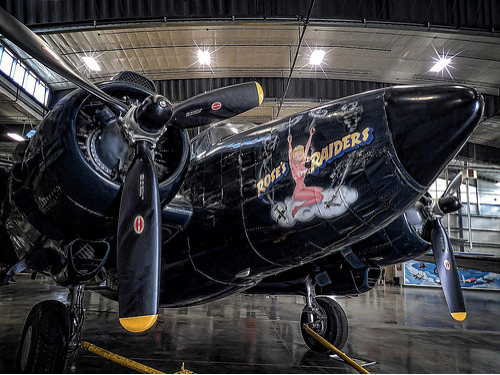
PV-2 Harpoon
NARRATIVE
Lockheed’s PV-2 is an outgrowth of the U.S. Navy’s PV-1 patrol bomber program. However, the Navy considered the PV-1 to have marginal take-off performance characteristics when completely loaded. To rectify this situation, Lockheed’s Vega Division was commissioned to revise the design to increase the aircraft’s range and handling overall performance. The redesign turned into a major project that incorporated so many changes that the resulting aircraft was given the new designation of PV-2 Harpoon. The wingspan of the PV-2 was increased to 75 feet which offered more room for additional fuel tanks and the bombardier's position was eliminated. The offensive and defensive armament for the PV-2 consisted of an assortment of 50-caliber machine guns spread among the upper and lower nose positions, the dorsal turret and the rear ventral position. The Harpoon was also capable of carrying 4,000 pounds of bombs and eight 5-inch rockets beneath the wings. In June 1943, the Navy ordered 500 PV-2s and the first model took to the air on 3 December 1943. Beginning in March 1944, over 500 were delivered and saw action in the Pacific Theater. The Navy continued to use the Harpoon until August 1948 when all existing aircraft were transferred to Naval Reserve units. Many surplus PV-1s and PV-2s were converted into executive transports or employed as crop sprayers. The museum’s Harpoon is one of only a few survivors still flying.
SPECIFIC HISTORY
The Museum’s rare PV-2D was the first D model built out of a production of only 35. It operated from numerous Naval bases including NAS Alameda and NAS Cherry Point before being retired to the U.S. Navy’s aircraft storage facility at Litchfield Park, Arizona in December 1956. It began its civilian career the following year through purchase by several owners who used the craft primarily as a sprayer. It was restored to its original military configuration in 1989 and acquired by the museum in 1999.