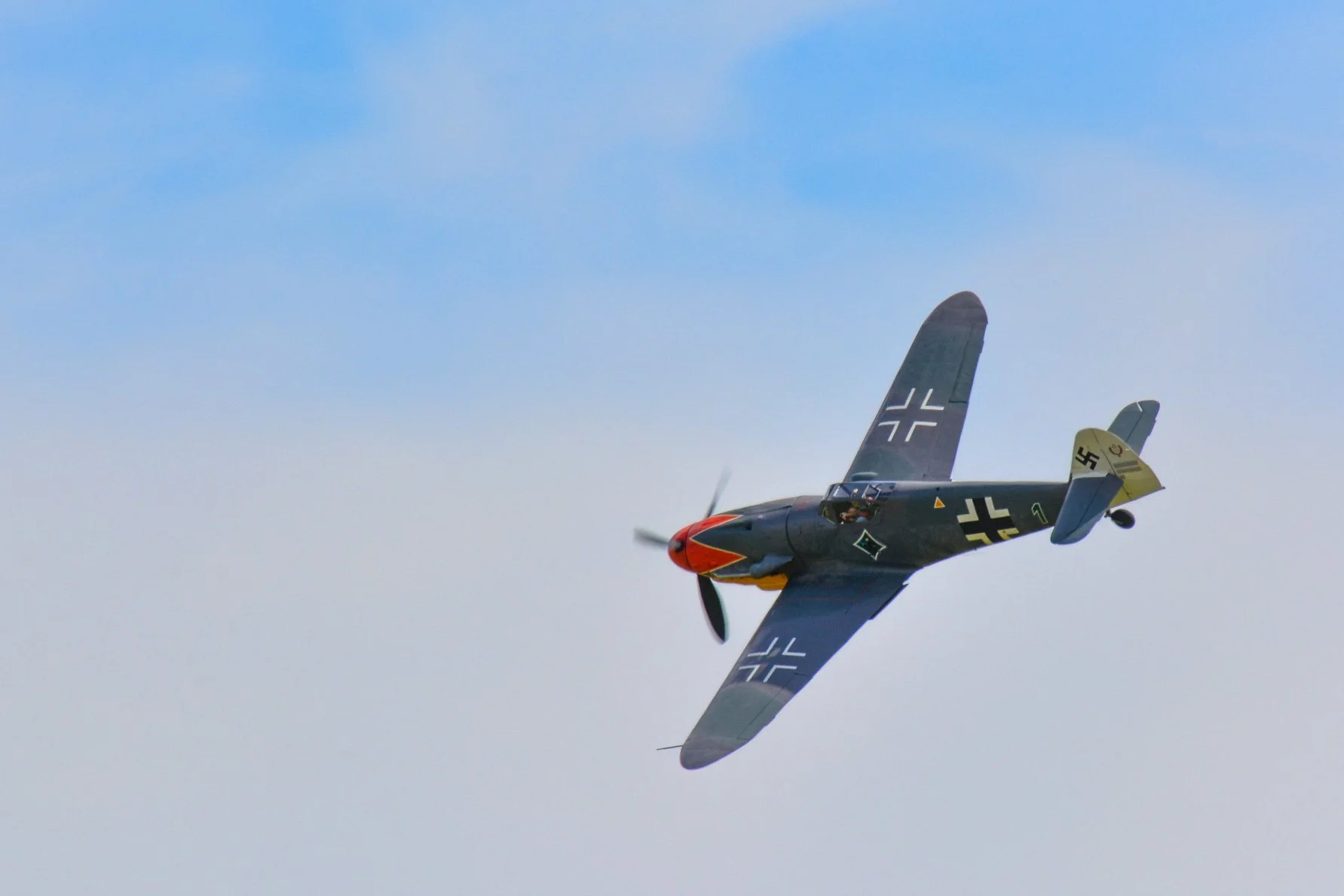
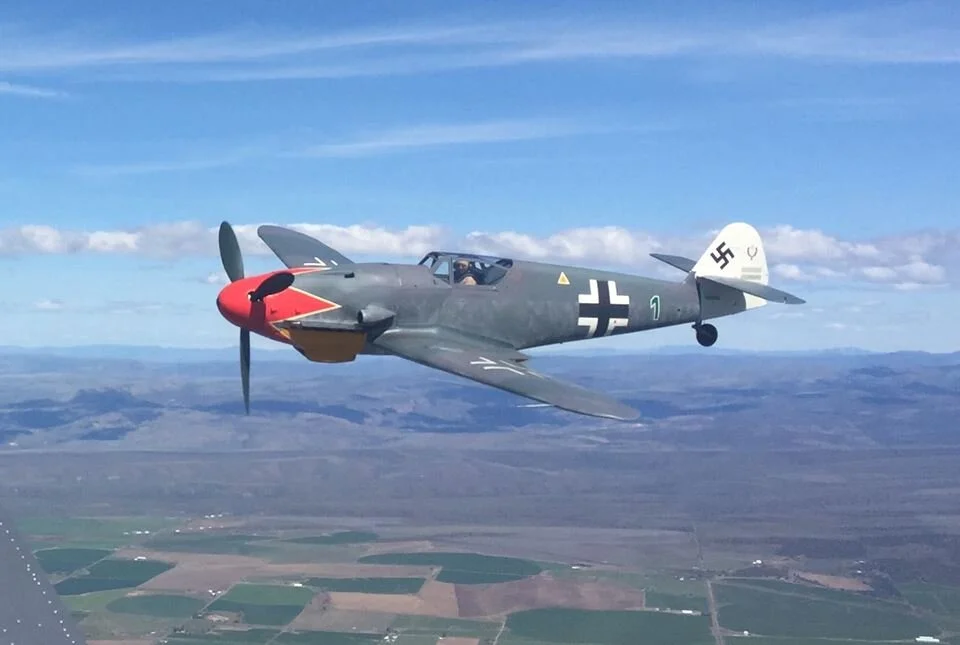
Messerschmitt Me-109
NARRATIVE
When the Messerschmitt Me-109 first took to the air in September 1935, a new age in aviation history began. At that time, nearly all of the world’s air forces flew aircraft that were open cockpit, fixed under carriage monoplanes or bi-planes.
Willy Messerschmitt’s design incorporated many revolutionary features that were carried over from his earlier civilian sport plane, the Bf-108. Early Messerschmitt models began with the prefix “Bf” to designate Bayerische Flugzeugwerke, the firm’s name prior to 1938. Innovations in the Bf-109 included an all metal body, retractable landing gear, an enclosed cockpit and automatic wing slats to counter stalling in high speed turns. The capabilities of this new aircraft were demonstrated to the world during the 1936 Berlin Olympics and in Zurich at the Military Aircraft Competition. At the latter, it claimed top honors and received international acclaim. The 109 was placed into production shortly thereafter and made its combat debut in 1937 when the German military assisted Francisco Franco in winning the Spanish Civil War. The Me-109 went on to become the mainstay of the German Luftwaffe’s fighter force during World War II, as a fighter/bomber, photo reconnaissance plane and trainer. Throughout its lengthy career, the Messerschmitt was constantly improved to keep pace with the rapid advances in wartime aviation technology. The most numerous production series, the Me-109G, or Gustav, dates from May 1942 and was powered by the superb Daimler-Benz DB605, a 1,475 hp inline engine which gave the warplane a top speed of 387 mph. Armament carried by Messerschmitts consisted mainly of two cowl-mounted 7.9mm or 13mm machine guns and one 20mm or 30mm cannon that fired through the propeller hub. This firepower was often augmented by the addition of two wing-mounted cannon. The plane also spent the war in the air forces of other nations including those of Rumania, Hungary, Finland and Switzerland. Postwar production continued in Czechoslovakia and in Spain until 1958 and in all totaled some 35,000 units, the largest number ever built of one aircraft type. Many consider the Me-109 to be the greatest fighter plane in aviation history. This aircraft started a revolution in worldwide fighter design with its conception in 1935. Throughout the modifications in its airframe and power plant, the Messerschmitt remained a fine combat plane for the better part of a decade. Even as late as 1945, in the twilight of its Luftwaffe service, the Me-109 was able to match the performance of the allied aircraft it encountered in the skies over the collapsing German Reich.
SPECIFIC HISTORY:
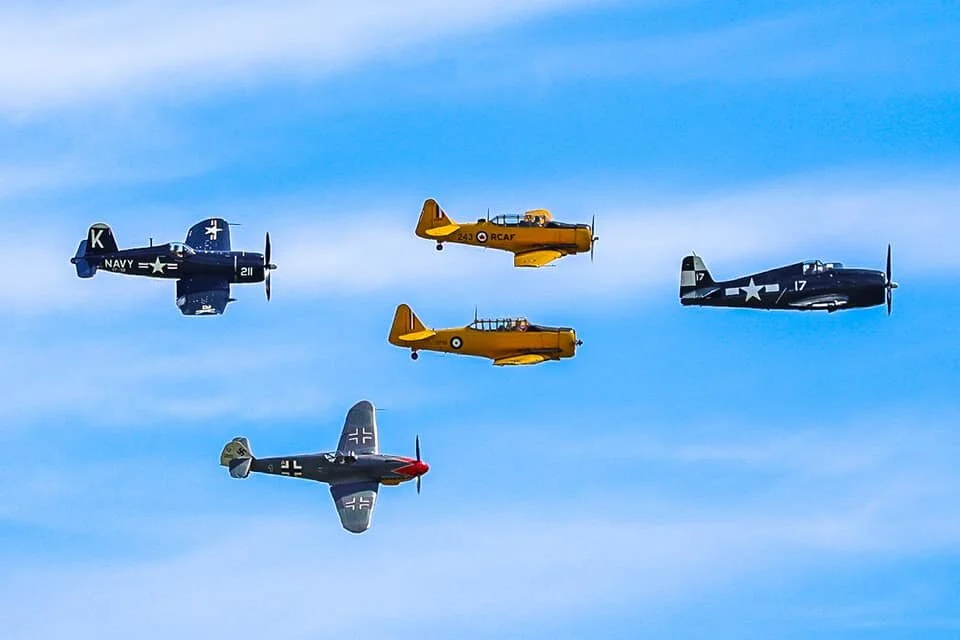
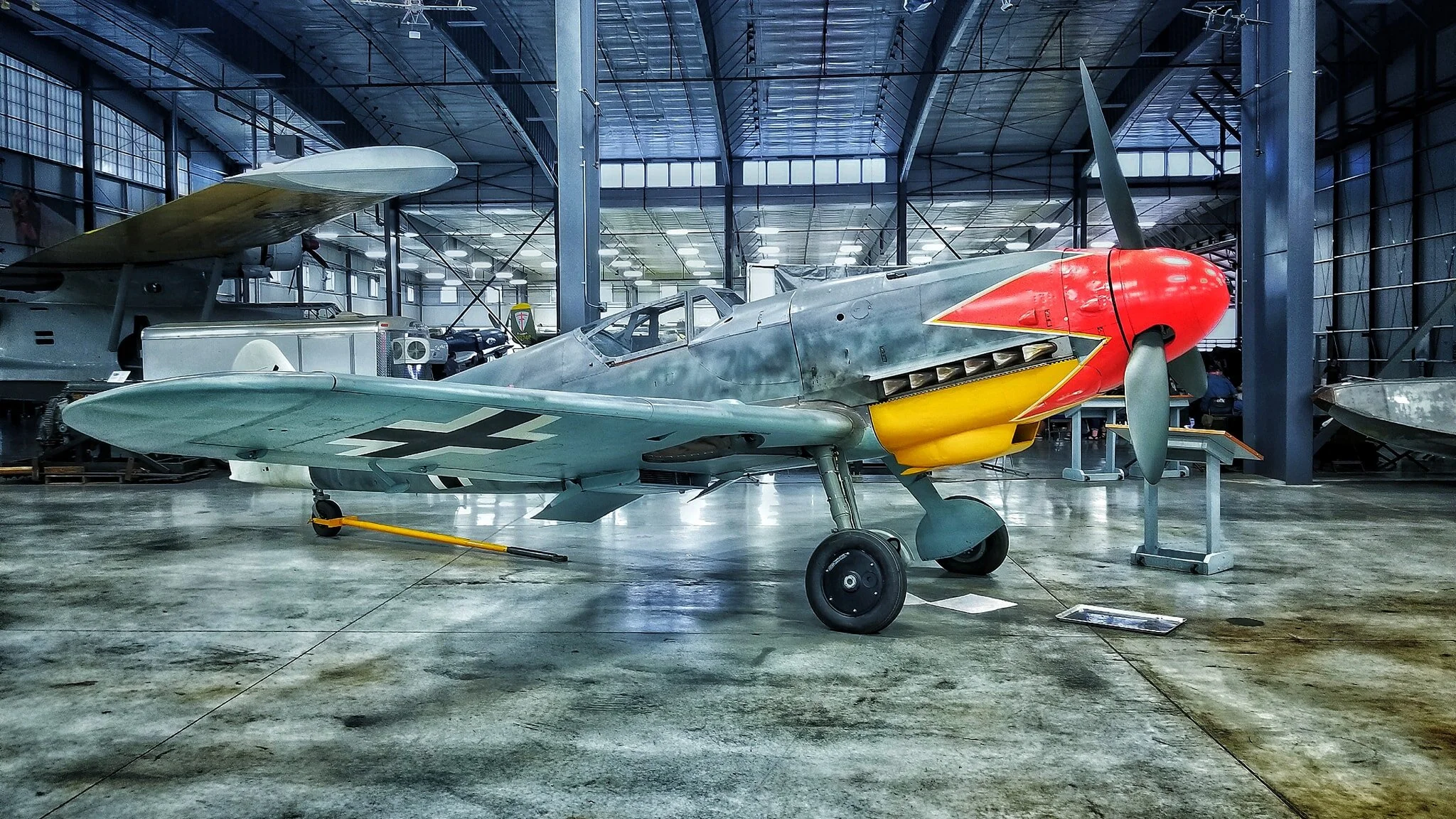
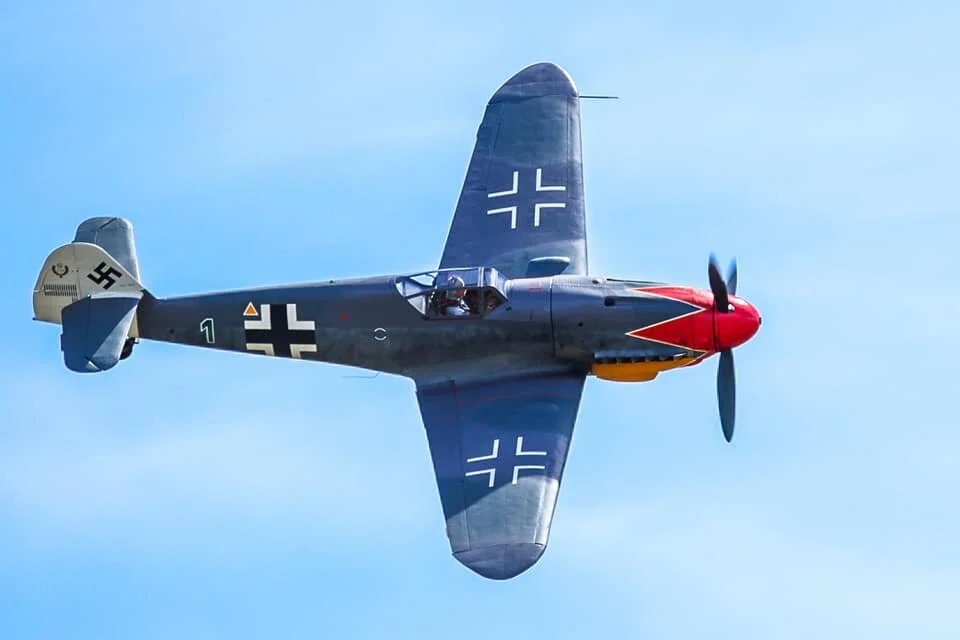
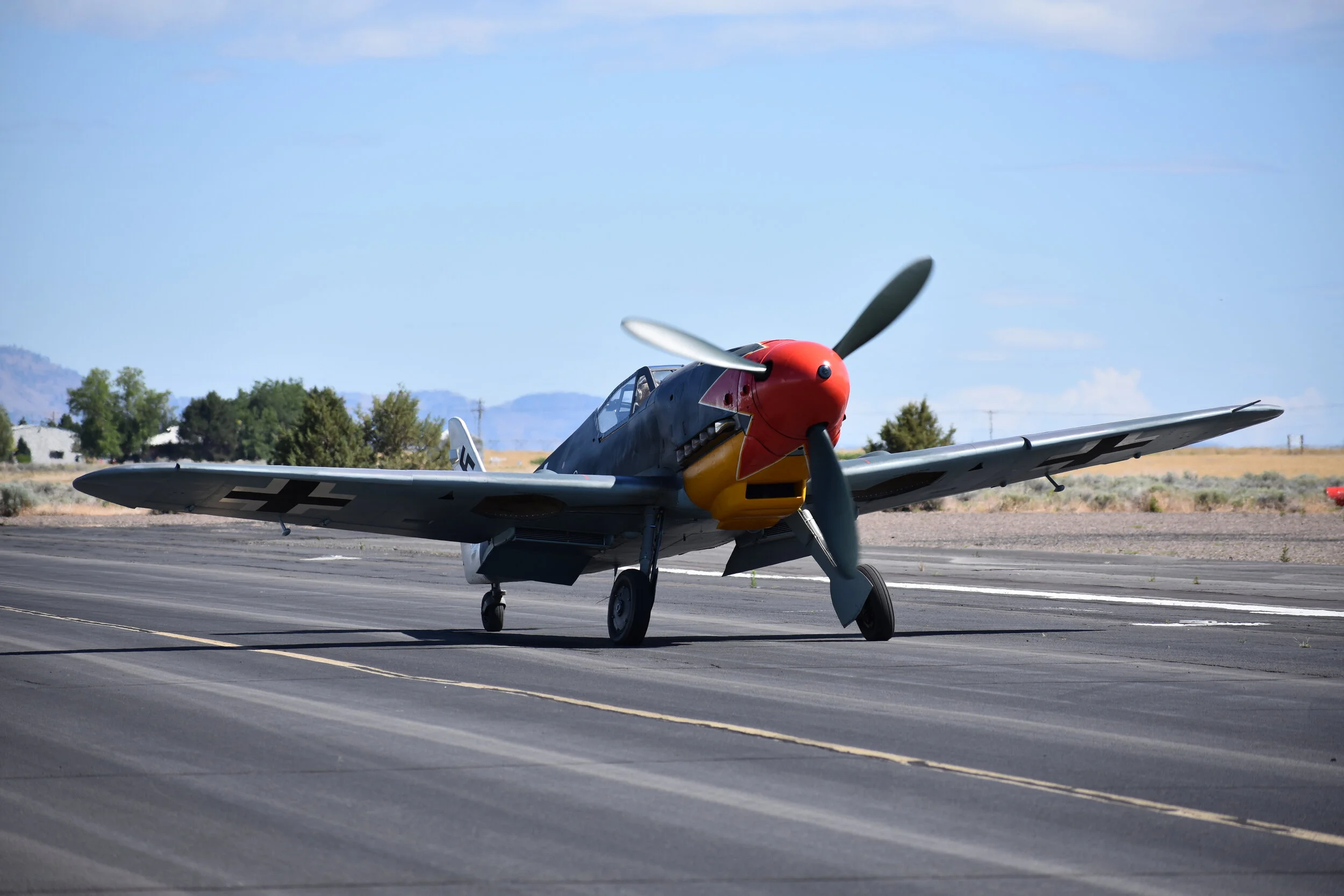
The aircraft on display was a Spanish built Buchon the last version of Willy Messerschmitt’s famous fighter – the German ME-109 – the scourge of Allied Forces in World War Two. The cowling used to house the powerful Rolls-Royce V-type engine gave the aircraft, designated as the HA-1112, a distinctive look with the updraft carburetor intake on the bottom. This reminded the Spanish of a large-breasted bird from Seville known as the Pouter Pigeon or Buchon, and Spain continued to produce their version of the Merlin-powered Messerschmitt well into the 1950’s, ultimately building 170 of the type. The collection’s BUCHON was one of 28 aircraft used to film the movie Battle of Britain. Jack Erickson purchased the aircraft from Connie Edwards in 1989. The collection’s newly restored (2017) airworthy aircraft was restored to fly with a lowered Allison V-1710 and fitted with genuine Bf-109 G-10 cowling and a reconfigured tail unit.